































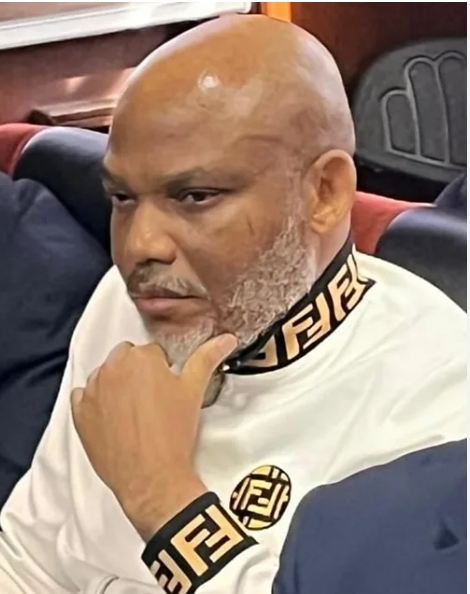
The sentencing of Nnamdi Kanu to life imprisonment has reignited one of the most delicate debates in Nigeria’s constitutional and political history. What began as a legal contest over jurisdiction has now become a test of national cohesion and, increasingly, a matter of international concern. Across the globe, critics have condemned the selective discretion that sees Kanu imprisoned while bandits and their sponsors walk free.
The stakes are no longer confined to the courtroom; they touch the fragile fabric of unity, justice, equity, and good conscience, and by extension, unity and peace. The question before President Tinubu is not simply legal; it is historical, moral, and political.
As a legal officer, I am not going against law as law. My opinion, however, is that law, however precise, cannot by itself resolve the deeper breaches of trust, the heavier fissures of belonging, and the more profound crevices of oneness. A sentence of life imprisonment, while legally valid, risks being perceived as disproportionate when set against Nigeria’s broader practices of leniency and the global test of justice. Boko Haram insurgents have been granted amnesty; bandits and kidnappers evade prosecution. Against this backdrop, the continued incarceration of Kanu risks appearing selective, even punitive, in ways that inflame rather than pacify.
Voices across the federation – from Afenifere and Ohanaeze Ndigbo, to Southeast lawmakers led by Senator Enyinnaya Abaribe, to Mrs. Bianca Ojukwu, to Imeh Bishop Umoh, to Malcolm Emokiniovo Omirhobo, to the Arise Television journalist, Rufai Oseni – have urged President Tinubu to temper justice with mercy. Several people have questioned the rationale for allowing Sheikh Gumi to continue to negotiate on behalf of insurgents like Boko Haram while Kanu has been sentenced to life imprisonment.
The popular Nollywood actor, Imeh Bishop Umoh, for example, refers to Gumi as a proven banditry apologist and says his activities are “visible to the blind and audible to the deaf.” Likewise, human rights activist, Malcolm Emokiniovo Omirhobo, has questioned the rationale for allowing Gumi, the negotiator on behalf of armed bandit groups, to continue walking freely on the streets while Kanu is left to rot in jail. While Omirhobo sees the prosecution of one man for speech and the celebration of another for advocating for bandits as selective justice, I see it as specious, duplicitous, fraudulent, and paradoxical.
Among the critics is Gunther Fehlinger-Jahn, chairman of the Austrian Committee for NATO, who has called for Kanu’s prompt release – underscoring that Nigeria’s handling of this case is being watched far beyond its borders.
Apart from the one-man appeal of Fehlinger-Jahn, the Diaspora Advocacy Groups (UK and US), comprising several Igbo diaspora organisations in London, Washington, and New York, while pooh-poohing the deceptive façade – quite obvious in the government’s selective justice of granting amnesty to Boko Haram fighters while imprisoning Kanu for speech and political agitation – have embarked on protests, and pledged “a luta continua.”
Also, Human Rights Watch, in corroboration, has echoed the Diaspora Advocacy Groups’ rallying cry of “the struggle continues” with the affirmation vitória é certa – “victory is certain.” Indeed, Human Rights Watch has constantly condemned Nigeria’s repugnant application of justice, which often reintegrates militants while giving political dissidents harsh sentences. Kanu’s supporters invoke this broader critique to frame his case as emblematic of selective discretion.
Moreover, Amnesty International (Global) has repeatedly criticised the one-sidedness of the government in the handling of political prisoners and has unceasingly called for equitable justice.
Furthermore, Diaspora Intellectuals and Activists, comprising Europe and North Americas’ Nigerian academics and activists have, through op-eds and organised forums, caricatured the paradox, warning that Nigeria’s asymmetrical and out of plumb justice is detrimental to its international reputation.
These criticisms show that the Kanu case is not just a Nigerian issue but a global controversy.
If Tinubu hardens his hand, history will record him as the leader who chose retribution over reconciliation, and the embers of grievance may smoulder into flames of unrest. If he softens his hand, history will remember him as the statesman who turned a potential martyrdom into a moment of healing, and the seeds of peace will take root.
If mercy is withheld, the South East may interpret justice as persecution, and the nation’s unity will fray. If mercy is extended, the South East may interpret justice as compassion, and Nigeria’s unity will be renewed. If Kanu remains behind bars, his silence may echo louder than his words, and generations may inherit resentment. If Kanu is released, his freedom may echo louder than his defiance, and generations may inherit reconciliation.
President Tinubu now stands at a crossroads where law has delivered its verdict, but leadership must supply its wisdom. To leave Kanu’s sentence untouched is to risk deepening wounds that already divide the nation; to exercise mercy is to signal that Nigeria’s future will be built on inclusion rather than exclusion. The measure of statesmanship is not in the rigidity of punishment but in the courage to heal. If Tinubu chooses the path of clemency, he will show that justice in Nigeria can be tempered by conscience, and that unity is best secured not by force, but by foresight. The law has spoken; history now waits to see whether politics will reconcile.
* Babatunde, a legal practitioner, lectures at London South Bank University, UK.