
































There are moments in every nation’s legal history when a single court ruling forces the country to confront an uncomfortable question: Are we a nation governed by laws, or by the moods and improvisations of those who interpret them?
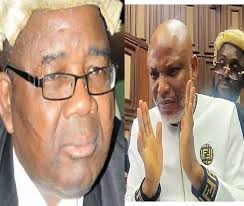
Justice Binta Nyako’s court produced one such moment in 2017. Now, Justice Omotosho of the Federal High Court has produced another.
At the center of this legal storm is one man: Mazi Nnamdi Kanu, and one disturbing judicial choice: to insist on conducting a criminal trial under a repealed law.
This is not merely a legal technicality.
It is a constitutional earthquake.
The Law Is Clear: A Repealed Statute Cannot Sustain a Trial
In any country that claims to operate under the rule of law, this would not even be a debate.
The Terrorism (Prevention) (Amendment) Act 2013 (TPAA) was repealed by the Terrorism Prevention and Prohibition Act 2022 (TPPA).
This is not an opinion.
It is a matter of record.
Yet in ruling after ruling—both in the no-case submission and the final judgment—Justice Omotosho never once took judicial notice of this repeal.
Instead, he inserted the now infamous phrase:
“Assuming, without conceding, that the TPAA is repealed…”
Assuming?
Without conceding?
One does not “assume” a repeal.
One acknowledges it as a matter of law.
The Evidence Act mandates courts to take judicial notice of all enacted laws.
Supreme Court decisions—from NNPC v Fawehinmi to Abacha v Fawehinmi—state clearly that failure to take judicial notice of the law vitiates proceedings.
Not weakens them.
Not complicates them.
Nullifies them.
Yet here we are.
The Savings Clause Cannot Resurrect a Dead Law.
Defenders of Justice Omotosho have clung to Section 98(3) of TPPA like a drowning man to driftwood, insisting it allows the judge to proceed under TPAA as if TPPA never existed.
But this is intellectually dishonest.
Savings clauses do not and have never resurrected dead statutes.
Nigerian case law is overwhelming:
AG Lagos v Dosunmu — repeal extinguishes the legal force of the old law.
Uwaifo v AG Bendel — a repealed statute cannot be used to impose new liabilities or sustain ongoing proceedings unless properly migrated.
Afolabi v Governor of Osun State — a savings clause preserves rights, not jurisdiction.
Savings clauses preserve past liabilities, not procedural frameworks.
You cannot run a 2024 trial under a 2013 law simply because both once dealt with terrorism.
If this logic stood, Nigeria could still conduct trials under:
the 1979 Constitution,
military decrees from 1998,
or even colonial ordinances.
The absurdity speaks for itself.
The Supreme Court’s Misstep and the Ripple Effect
It is no secret in legal circles that the Supreme Court’s December 2023 judgment created the confusion Justice Omotosho is now exploiting.
In what can only be described as a per incuriam oversight, the Court declared that TPAA and CEMA were “extant” when both had been repealed.
That single line has now become a shield for judicial stubbornness.
But even the Supreme Court cannot breathe life into a repealed statute.
If they made an error, the remedy is clarification—not perpetuation.
Why Nigerians Should Be Worried
This is not about sympathizing with Nnamdi Kanu.
This is about what kind of judiciary Nigerians want.
Because if a judge can ignore:
the Constitution,
the Evidence Act,
binding precedents,
and an extant federal statute…
…then every Nigerian citizen is vulnerable.
If a repealed law can be used today because a judge “assumes without conceding” that it was repealed, then no one is safe from arbitrary prosecution.
When legality becomes negotiable, liberty becomes expendable.
The Human Cost of Institutional Pride
Some ask: Why won’t Justice Omotosho simply apply the correct law?
The answer is uncomfortable:
Admitting the mistake would unravel the entire trial and embarrass the judicial establishment.
And nothing terrifies the Nigerian judiciary more than public embarrassment.
So instead of correcting the error, the system doubles down.
Instead of acknowledging illegality, it manufactures logic to justify it.
Instead of upholding justice, it protects institutional ego.
Meanwhile, one man—whether you support his politics or not—sits in solitary confinement, his liberty suspended, his health deteriorating, all because the system prefers stubbornness over justice.
A Judiciary Must Choose: Law or Ego
What is at stake here is not Mazi Nnamdi Kanu’s personality.
It is the soul of Nigerian jurisprudence.
A judiciary that refuses to obey its own laws is not a court of justice.
It is a court of convenience.
Justice Omotosho’s ruling must not be allowed to stand—not because of politics, but because of precedent.
If this judicial experiment is permitted to settle into law, Nigeria will wake up one day to find that:
statutes no longer matter,
repeals no longer matter,
jurisdiction no longer matters,
and due process is whatever a judge says it is.
That is the road to judicial anarchy.
And Nigeria has suffered enough.