

















By Georgina George
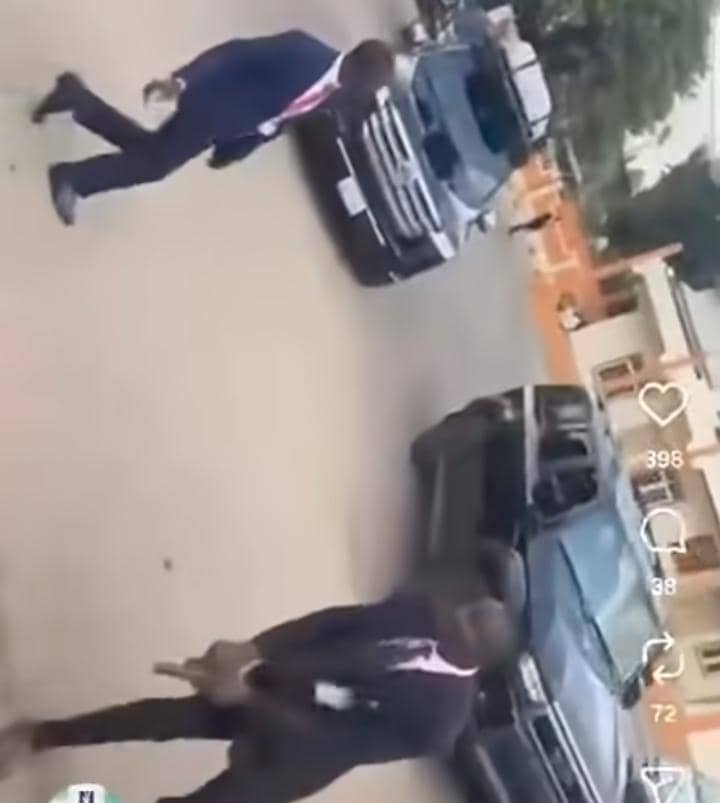
President Bola Tinubu’s convoy came under attack on Friday as angry youths chanting “Ba ma so” and “Ba ma yi” threw stones at vehicles in his motorcade shortly after he attended Juma’at prayers in Abuja.
The incident, which unfolded around the Shagari Mosque in Area 1, Garki, saw security operatives attached to the presidential convoy confronted by a visibly agitated crowd as the President prepared to leave the mosque.
Videos circulating on social media captured the tense moments, with some members of the crowd shouting the Hausa expressions meaning “we do not want you” and “we are not doing” while hurling stones towards vehicles in the presidential motorcade.
The situation reportedly escalated as the crowd gathered around the convoy, with security operatives seen drawing their weapons while attempting to contain the disturbance and protect the presidential vehicles.
In another footage from the incident, some youths were seen pulling down and destroying campaign posters and banners bearing Tinubu’s image and the insignia of the ruling All Progressives Congress (APC), with some openly expressing opposition to the President.
The confrontation has raised fresh questions about the growing hostility towards Tinubu, particularly as his administration approaches another election cycle amid mounting public discontent over economic conditions and governance.
Since Tinubu assumed office on May 29, 2023, his administration has introduced far-reaching economic policies, beginning with the removal of the petrol subsidy announced during his inauguration and followed by the liberalisation of the foreign exchange market.
While the government has defended the measures as necessary to stabilise the economy, their consequences have placed considerable pressure on households and businesses, with transportation costs, food prices and other essential expenses rising sharply.
For millions of Nigerians, the reforms have translated into a prolonged struggle to cope with the rising cost of living, declining purchasing power and the increasing difficulty of meeting basic household needs.
Although the administration has repeatedly pointed to improvements in some economic indicators and defended its policies as necessary for long-term recovery, public frustration over hardship, insecurity and the state of the economy remains a major challenge for the government.
Friday’s incident also comes against the backdrop of growing political activities ahead of the 2027 general elections, with opposition parties and their supporters intensifying criticism of Tinubu’s administration and challenging his re-election prospects.
However, the circumstances surrounding the confrontation at the mosque remain contested. Footage from the incident showed a vehicle bearing the presidential flags among those in the convoy, although it was not independently established whether Tinubu was inside the particular vehicle targeted by the stone-throwing.
Tinubu’s Senior Adviser on Digital and New Media, O’tega Ogra, subsequently released a 14-second video showing the President greeting worshippers after the prayers, describing reports of an attack on the convoy as a misleading narrative being promoted by opposition supporters.
The President’s media aide, Bayo Onanuga, also dismissed reports of the attack, telling Peoples Gazette: “This is not true.”
Despite the denials, footage of the confrontation continued to circulate online, drawing attention to the security challenges surrounding the President’s public engagements and the growing political tensions ahead of the 2027 elections.