






















Teachers and parents in Ebola-hit eastern Democratic Republic of Congo (DRC) have expressed concern over the planned reopening of schools amid inadequate preventive measures against the disease.
Schools are scheduled to reopen nationwide on September 1, but reopening in Ebola-affected areas will depend on local transmission risks.
The outbreak has recorded 5,713 confirmed cases and 2,744 deaths, according to the report.
The Ministry of National Education has classified schools into green, orange and red zones based on levels of Ebola transmission.
Authorities said 2,890 schools are considered at high risk, with different preventive measures applying to each category.
Schools in green and orange zones will hold physical classes with preventive measures, while those in red zones will adopt home-based learning.
Patrick Urunga, president of a teachers’ inter-union group in Ituri, urged authorities to delay reopening schools without adequate health safeguards.
He said reopening schools without sufficient protection could expose students, teachers and their families to Ebola infection.
Teachers called for stronger disease-control measures, handwashing facilities, protective equipment and other preventive measures before reopening.
The Africa Centres for Disease Control and Prevention (Africa CDC) said authorities had decided to proceed with reopening after considering a possible postponement.
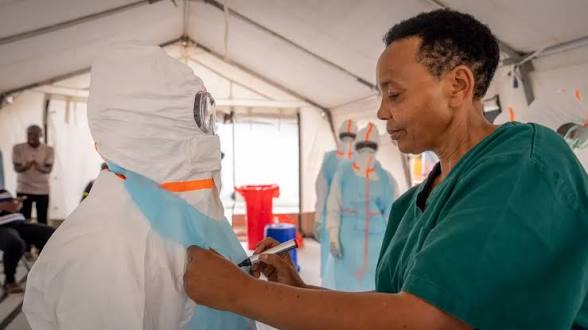
Yap Boum II, head of Emergency Preparedness and Response at Africa CDC, said teachers were being trained on Ebola prevention.
He said infection prevention measures were being prepared for about 3,000 schools in Ituri, the epicentre of the outbreak.
Where water access is limited, schools are expected to provide alcohol-based hand sanitisers, while students will undergo temperature checks.
Authorities are also considering alternating classes in overcrowded schools, although discussions on the arrangement were still ongoing.
Families in Bunia, Ituri’s provincial capital, expressed mixed feelings, with some buying school supplies while remaining uncertain about sending their children back.
Giselle Uchima, a mother of two, said families wanted children to resume learning but remained concerned about bringing Ebola infections home.
In North Kivu, authorities in Butembo said they were awaiting instructions from the central government on whether schools would reopen.
Butembo and nearby Beni have been severely affected by the outbreak, with resistance and attacks against health workers complicating response efforts.
The United Nations Children’s Fund (UNICEF) said children accounted for about 21 per cent of confirmed cases but nearly one-third of reported deaths.
The outbreak, caused by Bundibugyo ebolavirus, has spread to six provinces: Ituri, North Kivu, South Kivu, Bas-Uele, Haut-Uele and Tshopo.NAN