






























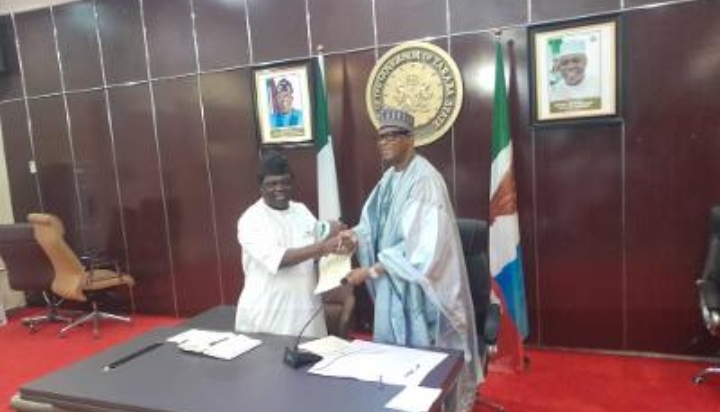
When the Federal Ministry of Housing and Urban Development handed over 188 completed housing units to the Taraba State Government last week in Jalingo, it did more than close one item on a construction schedule.
It provided Nigerians with a tangible indicator that a federal commitment is being implemented.
Under the leadership of the Hon. Minister of Housing and Urban Development, Engr. Muttaqa Rabe Darma, PhD, and the Hon. Minister of State, Rt. Hon. Yusuf Abdullahi Ata, the Ministry has positioned the National Housing Programme as the operational basis of President Bola Ahmed Tinubu’s Renewed Hope Agenda on housing.
The Taraba handover is not an isolated event. It is a demonstration — evidence that the systems behind the Agenda are producing housing units, not only announcements.
What distinguishes this handover is the delivery model. Rather than allow completed units to remain in government inventory, the Ministry is encouraging state governments to acquire and allocate the houses directly to citizens — including civil servants, security personnel, and working families. This represents a pragmatic adjustment in approach, prioritizing delivery timelines over procedural delay.
Minister Darma’s position was direct: the houses “must be functional, and they must be occupied.” That is not ceremonial language. It is language of accountability.
The public acknowledgment by Governor Agbu Kefas, and the state’s stated commitment to a transparent allocation process, is also significant. The effectiveness of federal housing interventions is ultimately determined at the point of distribution.
A state government that publicly commits to transparent allocation reflects the kind of federal-state alignment required for the Renewed Hope Housing Agenda to function at scale.
It would be premature to conclude that Nigeria’s housing deficit has been addressed on the basis of 188 units in one state. The deficit runs into millions.
The substantive test of the Renewed Hope Agenda will be whether the Taraba model — direct state acquisition, timely allocation, and verifiable occupancy — is applied consistently across the 36 states, and not only in contexts where conditions are favorable. Delivery, not declaration, remains the relevant measure.
Nonetheless, recognition is warranted where due. Under Minister Darma and Minister of State Ata, the Ministry has moved from policy statements to physical structures available for occupation. That is the distinction between an agenda on paper and an agenda under implementation.
If the Taraba template is sustained and adopted by other states, the Renewed Hope Housing Agenda may become one of the more measurable components of this administration’s domestic policy record — one house, and one handover, at a time.
Adamu Aminu.
Special Assistant on Media to the Hon. Minister of State,
Federal Ministry of Housing and Urban Development.
Abuja.