






























By Daniel Nduka Okonkwo
Across Nigeria’s major cities, finding a decent place to live has become an increasingly painful financial struggle for ordinary Nigerians. For millions of workers, house rent is no longer just another household expense; it is consuming an alarming share of their earnings, leaving little for food, transportation, healthcare, children’s education, and other necessities. The commonly used international housing affordability benchmark recommends that households spend no more than 30 percent of their income on housing. Yet a report by Pison Housing Company, estimates that Nigerian renters spend more than 50 percent of their income on rent. Some households face an even more severe burden.
The National Bureau of Statistics’ household expenditure surveys provide insight into housing costs, while World Bank research documents Nigeria’s growing urban housing deficits and the commuting difficulties associated with urban expansion. However, these sources do not establish how many Nigerian tenants have crossed that extreme affordability threshold. What is increasingly evident is that rising rents, sometimes accompanied by sharp increases in agency and legal charges, are placing low- and middle-income earners under enormous financial pressure. The widespread practice of demanding one or two years’ rent upfront makes the situation even more difficult, forcing many households to exhaust their savings, borrow money, or relocate in search of cheaper accommodation.
In Abuja, this financial pressure is particularly visible. A worker earning ₦100,000 monthly, equivalent to ₦1.2 million annually, who pays ₦800,000 in annual rent commits approximately 66.7 percent of gross annual earnings to accommodation alone. For those who cannot afford housing closer to their workplaces, the alternative is often to live in satellite communities across neighbouring Nasarawa State, including Keffi, Mararaba, and New Nyanya. But cheaper accommodation comes with another burden: long daily journeys into the Federal Capital Territory, rising transportation expenses, hours lost in traffic, and physical exhaustion. Money saved on rent is increasingly being spent on getting to work and returning home. For many families, living on the urban periphery is no longer a matter of preference but an economic necessity.
Behind these struggles lies a deeper question: how did securing a decent home become such a heavy financial burden in a country where millions of working people already struggle to meet their basic needs? Understanding the answer requires examining Nigeria’s housing policies, the rental market, the enforcement of tenancy regulations, the failure of affordable housing programmes, and the widening gap between workers’ incomes and the cost of accommodation.
Nigeria’s housing crisis is not simply a shortage of buildings. It is a growing failure of affordability, access, and security. Across Abuja, Lagos, Port Harcourt, Enugu, and parts of the country, workers with regular incomes struggle to secure decent accommodation. Tenants face demands for one or two years’ rent in advance, alongside agency commissions, legal fees, caution deposits, and management charges, often before receiving the keys to a property.
The official figures reveal the scale of the problem. On January 26, 2026, the Federal Ministry of Housing and Urban Development announced that its National Housing Data Technical Committee had estimated Nigeria’s 2025 housing deficit at 14.925 million units. On December 16, 2025, the ministry disclosed that approximately 15.2 million existing housing units were structurally inadequate. These figures measure different problems: one estimates the housing shortage, while the other concerns the condition of existing homes. They must not be added together as though they represent separate households.
Housing insecurity also takes the form of forced displacement, often leaving families without shelter and destroying the livelihoods they depend on. In a report published on November 4, 2026, Amnesty International stated that demolitions at Lagos’s Makoko Waterfront between December 2025 and January 2026 displaced more than 50,000 residents and destroyed approximately 5,000 homes, 42 schools, and 20 clinics, part of a wider wave of demolition exercises that also affected Oworonshoki and Mile 12. These figures relate specifically to the affected communities in Lagos and should not be interpreted as nationwide displacement statistics. However, they illustrate the human cost of insecure housing, forced evictions, and demolitions, particularly when residents lose not only their homes but also access to essential services and sources of livelihood.
The rental market exposes another dimension of the crisis. An investigation by the International Centre for Investigative Reporting (ICIR), published on December 15, 2025, documented excessive agency commissions and additional charges imposed on prospective tenants in Enugu. Some agents reportedly charge as much as 30 per cent of annual rent. One one-bedroom apartment in New Haven advertised at ₦700,000 annually attracted another ₦650,000 in legal, caution, management, and agency charges, bringing the initial payment to ₦1.35 million.
Okey Mbah, the lawmaker representing Nkanu East and sponsor of the Enugu tenancy amendment bill, cited examples during legislative proceedings. According to him, a flat advertised at ₦300,000 ultimately required ₦950,000, while another advertised at ₦500,000 attracted demands of up to ₦1.4 million. Although these were legislative examples rather than independently audited transactions, they illustrate the rental-market practices documented by ICIR. For workers earning monthly salaries, such demands can mean borrowing money, selling business capital, or exhausting personal savings.
On November 17, 2026, the Enugu State House of Assembly passed the Landlord and Tenant (Amendment) Bill, House Bill No. 3 of 2025, following its third reading. The bill had earlier passed its second reading on March 11, 2026, before undergoing a public hearing on March 26, 2026.
According to the proposed amendments, landlords would be restricted from increasing rent during the first four years of a tenancy, while subsequent increases would be capped at 2 percent. An increase of up to 10 percent would be permitted only where substantial and verifiable renovations have been carried out. The proposals also seek to cap agency fees at 5 percent of the annual rent, legal fees at 10 percent, and refundable caution deposits at 10 percent.
The intervention followed years of complaints about rising rents. In July 2024, Kindness Jonah of the Civil Liberties Organisation led a protest in Enugu against escalating rental costs. Speaker Uche Ugwu has described the bill as providing tenants with safeguards against arbitrary increases.
However, the bill is not yet law. It requires Governor Peter Mbah’s assent. Landlords have also raised objections. Onyekwere Johnson, a landlord in Enugu, described the proposed restrictions as unrealistic and difficult to enforce, citing inflation, electricity tariffs, and rising building-material costs. These concerns deserve consideration, but economic pressures on property owners cannot justify arbitrary charges or exploitation. Effective regulation must protect tenants without discouraging investment in residential housing.
The problem extends beyond Enugu. Lagos State has operated under a Tenancy Law since 2011. Section 4 prohibits landlords and agents from demanding more than one year’s rent in advance from new tenants. Yet rental exploitation persists, demonstrating that legislation without consistent enforcement, public awareness, and accessible dispute resolution offers limited protection.
In the Federal Capital Territory, the House of Representatives is considering the Federal Capital Territory Advance Rent Regulation and Tenants’ Protection Bill, 2026, HB 2839, sponsored by Paul Nnamchi and Ahmed Doro. It passed first reading on October 22 and second reading on November 4, 2026. The proposal seeks to bar demands for more than 12 months’ rent in advance, regulate agents and rent increases, establish a Rent Regulation and Tenants’ Protection Authority, and provide mechanisms for refunds and penalties for violations. It remains a legislative proposal, not an enacted law.
Government housing programmes must also be measured against citizens’ incomes. The National Minimum Wage Amendment Act 2024 sets the minimum wage at ₦70,000 monthly. Published price lists for Renewed Hope City at Karsana, Abuja, placed a two-bedroom apartment at ₦48.5 million. At the full minimum wage, this represents approximately 693 months of earnings, or nearly 58 years, assuming the worker spends nothing on food, transportation, healthcare, or other necessities.
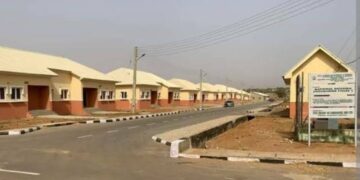
Under the lower-priced Renewed Hope Estates category, the ministry announced prices of ₦8.5 million, ₦11.5 million, and ₦12.5 million for one, two, and three-bedroom bungalows, respectively, in October 2025. A two-bedroom property at ₦11.5 million represents approximately 164 months, or nearly 14 years, of the full minimum wage. These calculations exclude all other living expenses.
Offering instalment payments or mortgage arrangements does not automatically make housing affordable. Government must disclose initial deposits, interest rates, repayment periods, eligibility requirements, completed units, and allocation records. Nigerians deserve to know how many homes have actually been delivered, who receives them, and whether ordinary workers can realistically afford them.
Section 16(2)(d) of the 1999 Constitution, as amended, directs the State to ensure suitable and adequate shelter, food, and a reasonable national minimum living wage for citizens. Although Section 6(6)(c) generally limits judicial enforcement of Chapter II’s Directive Principles, the constitutional provision remains an important standard for evaluating government performance.
Nigeria does not lack housing announcements. What remains in question is delivery. Federal and state governments should publish housing expenditure, completed units, beneficiary records, and actual costs. They must also enforce tenancy protections and establish accessible channels for complaints against landlords, agents, and property managers.
If Governor Mbah signs the Enugu bill, its implementation will provide an opportunity to test whether effective regulation can curb exploitation without undermining investment.
The question confronting Nigeria’s leadership is straightforward: if citizens work, earn salaries, and contribute to the economy, why has securing a decent home become such a punishing financial struggle? Governments should deliver measurable housing supply, enforceable rental protections, and transparent public spending; the promise of affordable housing will remain largely unfulfilled.
Daniel Nduka Okonkwo is an investigative journalist, human rights advocate, and policy analyst based in Nigeria. He is the founder and publisher of Profiles International Human Rights Advocate (PIHRA), a platform documenting the courage of human rights defenders and examining issues of governance, accountability, security, and fundamental rights.
His reporting on Nigerian governance, security-sector accountability, public finance, and human rights has appeared in Sahara Reporters, Vanguard, Daily Trust, African Defence Forum, Opinion Nigeria, and Daily Intel.
Read more of his work on the PIHRA website:
https://www.profilesinternationalhumanrightsadvocate.com.ng/
For tips, feedback, or collaboration, contact him at dan.okonkwo.73@gmail.com.