






















By Daniel Nduka Okonkwo
This is best understood by those who have travelled. Restricted mobility is a difficulty Nigerians face repeatedly, and it is often the first hurdle between a capable Nigerian and an opportunity abroad. The record shows how costly that hurdle can be. Access is narrow and unstable: Henley placed Nigeria 89th, with 44 destinations in April; 90th, with 44 in July; and 92nd, with 45 in October. Its April report also records that Nigeria lost visa-free entry to several destinations in recent years, including Zambia, Zimbabwe, and Lesotho. The Ministry of Foreign Affairs analysis reported by Sunday Punch puts the cost of an unsuccessful visa application at ₦350,000 to ₦1.2 million, with refusal rates of 60.3 per cent in Belgium, 52.7 per cent in Spain, and 47.4 per cent in France. Those costs fall on people such as Adeyemi Anifowose, a Lagos-based web designer who spent nearly ₦2 million on a Schengen visa application for a Luxembourg master’s programme and was refused, and Joel Anyaegbu, who was refused twice for a trip to Barcelona. Across Africa, applicants forfeited about €60 million in rejected Schengen visa fees in 2024, while Nigeria recorded the second-highest number of denials on the continent. Neither case proves a national pattern on its own, but both sit within the 50,376 refusals recorded in 2024. A country carrying that share of the burden owes its citizens an account of what its diplomacy is doing about it.
Nigeria’s passport problem is usually reported as a ranking, a number that shifts each year before fading from public attention. The records show something larger. Some Nigerians travel abroad on documents carrying negotiated privileges, while millions of others pay non-refundable visa fees, wait for appointments, and risk losing opportunities that depend on being present. The issue is not whether governments should issue special passports to officials, since almost every country does so for legitimate purposes. The consequential question is whether Nigeria has used its diplomacy to widen access for ordinary citizens with the same determination it has shown in securing privileges for its representatives. On the public record, the answer is not reassuring.
The rankings show the scale of the disadvantage. In its October 2026 edition, the Henley Passport Index placed Nigeria 92nd of 199 passports, tied with the Democratic Republic of the Congo, Djibouti, and Laos, with access to 45 destinations. That followed 90th place with 44 destinations in July and 89th in April. In October 2026, Nigerian media reported that the IziVisa index placed Nigeria 181st of 196 countries, with 24 visa-free destinations, 16 offering visas on arrival, and 43 accessible by electronic visa. The Passport Index, using another method, credits Nigeria with 52. These measures are not interchangeable, because indices treat ties and electronic visas differently. Peers are far ahead on Henley’s measure. In the July edition, Ghana ranked 70th with 67 destinations and Kenya 68th with 70, while South Africa stood 49th with 101, and Seychelles and Mauritius ranked in the global top 30.
A ranking measures mobility, not the character or professional value of those who carry the passport. Visa restrictions reflect bilateral relations, reciprocity, migration patterns, security conditions, and confidence in national identity systems. No single cause explains them. But reciprocity and confidence are precisely what diplomacy and institutional reform exist to build, which is why Nigeria’s weak position is a question of performance and not only of circumstance. Ghana holds a stronger passport with a far smaller economy, and that gap cannot be explained by size.
The financial cost can be calculated from foreign government data. European Commission figures show that Nigerians lodged 111,201 Schengen short-stay applications in 2024 and that 50,376 were refused, a refusal rate of 45.3 percent. Some outlets report 45.9 percent, but the stated numbers produce 45.3. The Schengen fee was €80 until mid-2024 and €90 afterwards. At €80, the refused applications carried about €4.03 million in fees. At €90, they would carry about €4.53 million. The true figure lies between the two, and none of it was refundable. Across all 2024 applications, fees at the older rate come to about €8.9 million, which means nearly half of everything Nigerians paid in Schengen fees that year bought no travel permission.
The pattern worsened in 2025. The European Commission data, as compiled in public analyses, record 113,359 Nigerian applications and 53,196 refusals, a rate of 46.9 percent. At €90 per application, those refusals carry about €4.8 million in fees, or about €6.6 million if the €35 service-centre charge that many applicants also pay is included. A Ministry of Foreign Affairs visa-cost analysis obtained by Sunday Punch in November 2026 put rejected Schengen applications at about €11.5 million, roughly ₦19 billion, and total Nigerian visa spending at least ₦75 billion a year across all missions. The Schengen estimate is more than double what fees alone produce, which suggests it includes other costs. The Ministry should publish its method. Since 2014, Nigerian applicants have paid about €72.5 million in Schengen fees in total, according to public compilations, and that sum measures fees paid, not losses.
Beyond fees lies a less visible burden, a mobility tax on professionals, entrepreneurs, students, and businesses. Applicants may be asked to show sufficient funds, stable employment, and strong reasons to return, and some destinations require travel reservations, accommodation, and insurance before a decision is made. Appointment waits make short-notice travel difficult when negotiations, conferences, and competitions run on fixed schedules. Transit visa rules can complicate journeys even when the final destination allows visa-free entry. A founder missing an investment meeting, a researcher missing a conference, or a student missing an enrolment deadline may lose opportunities that cannot be recovered. Individual cases need documentary proof, but the mechanism is plain. When mobility is expensive and uncertain, opportunity moves elsewhere.
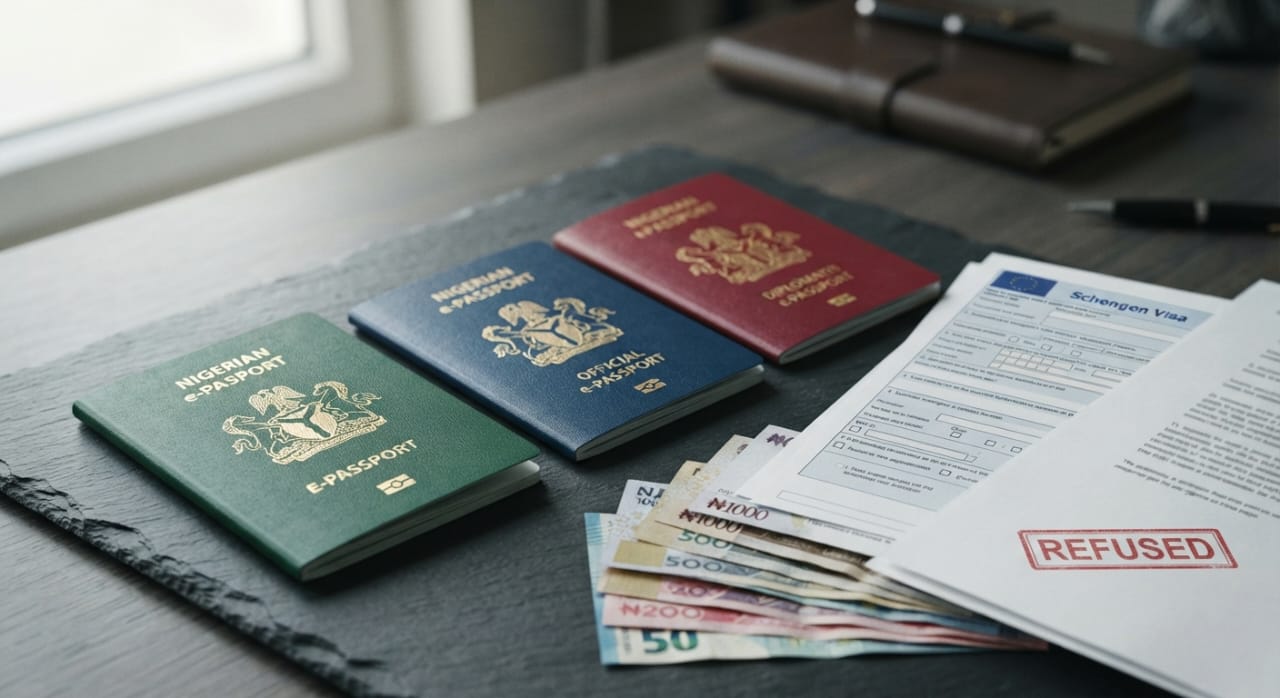
Nigeria’s passport system formalises the divide. The Nigerian Immigration Service lists standard, official, and diplomatic passports. The green standard passport serves citizens for ordinary travel. The blue official passport is meant for government personnel on authorised assignments, and the red diplomatic passport for recognised diplomatic representatives and others entitled under the rules. The Service’s own website sets out the eligibility. The official passport covers categories such as commissioners, special advisers, and deputy directors and above in the federal civil service, while the diplomatic passport covers Nigerian diplomats and other top officials approved by the President. One distinction matters. A diplomatic passport does not automatically confer diplomatic immunity, which depends on recognised diplomatic status and international law, not the colour of a document.
The bilateral record shows where diplomatic effort has gone. Nigeria’s Visa Policy 2020 lists reciprocal waivers for diplomatic and official passport holders from 13 countries: Kenya for diplomatic passports only, Mauritius, Namibia, Rwanda, South Africa, Sudan, Tanzania, Brazil, Cuba, Venezuela, Turkey, China, and Singapore. China’s foreign ministry separately lists an agreement with Nigeria, effective 1 February 2014, for diplomatic, service, and public-affairs passports, with stays under 30 days. Travel databases indicate that Nigerian diplomatic passport holders also enter Brazil, South Africa, and Turkey without visas. Ordinary Nigerian passport holders, by contrast, need visas for China, Brazil, and Turkey, and an electronic visa for South Africa. Waiver agreements signed with Vietnam in 2019 and Ethiopia in 2020 again covered only diplomatic and official passports. Such deals are routine, but the pattern is consistent. The Ministry has not shown that comparable access for ordinary citizens was ever sought, and the treaty texts would settle the matter.
Accountability also extends to the control of special passports. In 2015, the Nigerian Immigration Service urged 21 former governors, 42 former ministers, and 309 former members of the National Assembly to return their diplomatic passports. By June 2019, Saturday Punch reported that most still held them, prompting the service to threaten seizure at airports. A problem recurring across administrations demands scrutiny of eligibility regulations, enforcement records, and court decisions, distinguishing lawful retention from administrative non-compliance and proven fraud. There is, however, insufficient evidence to attribute Nigeria’s passport ranking or tighter foreign visa restrictions to specific incidents of passport misuse. A credible travel-document system requires transparent eligibility rules and consistent enforcement.
The question for the government is therefore plain: what measurable benefits are Nigeria’s diplomatic relationships delivering to ordinary passport holders? The Ministry of Foreign Affairs should publish its bilateral visa agreements, report on negotiations for broader citizen access, and explain the method behind its own visa-cost figures. The Nigeria Immigration Service should open its special-passport eligibility rules, issuance controls, and surrender records to scrutiny. The government should adopt a national mobility strategy with measurable targets, backed by regular review of refusal rates using European Commission, Home Office, and State Department data. A passport reflects the practical reach of a nation’s relationships. Nigeria must decide whether those relationships will keep serving the convenience of its political establishment or become an instrument of opportunity for its citizens.
Daniel Nduka Okonkwo is an investigative journalist, human rights advocate, and policy analyst based in Nigeria. He is the founder and publisher of Profiles International Human Rights Advocate (PIHRA), a platform documenting the courage of human rights defenders and examining issues of governance, accountability, security, and fundamental rights.
His reporting on Nigerian governance, security-sector accountability, public finance, and human rights has appeared in Sahara Reporters, Vanguard, Daily Trust, African Defence Forum, Opinion Nigeria, and Daily Intel.
Read more of his work on the PIHRA website:
https://www.profilesinternationalhumanrightsadvocate.com.ng/
For tips, feedback, or collaboration, contact him at dan.okonkwo.73@gmail.com.