













By Daniel Nduka Okonkwo
Mujahid Dokubo-Asari has made a reputation for saying provocative things, and by now, few people are surprised when he turns his attention to the Igbo again. The only question is when the next video will appear and what fresh accusation or sweeping generalisation it will contain. But let’s be clear about one thing: making noise on social media does not make someone an authority on history, and having an audience does not make personal opinions facts. His repeated attacks say far more about his political temperament than they establish anything about the Igbo people.
The Igbo are not defined by one man’s microphone. Not by Asari’s anger, not by his political frustrations, and certainly not by his social-media performances. Their history is longer than that. Their contributions to Nigeria and the international community are bigger than that. Across Nigeria and beyond, Igbo men and women are building businesses, establishing industries, creating employment, pursuing education, and contributing to economic development. That is the everyday reality that sweeping ethnic accusations cannot erase.
You cannot take a people numbering in the millions and portray them as the greatest problem facing Black people, even when you know that the Igbo, as an ethnic group, collectively disassociate themselves from militancy, terrorism, and banditry. There is no credible evidence to define the Igbo as an ethnic community by such criminality. Of course, individuals of Igbo origin can commit crimes, just as individuals from every other ethnic group can. But an individual’s wrongdoing remains that individual’s responsibility; it does not become the identity of millions of people. Asari’s videos are not historical evidence, and his opinions do not become facts.
The Igbo people do not need Asari’s approval, endorsement, or permission to retain their dignity. They never did.
Nigeria’s public discourse on ethnic relations faces another troubling test following remarks attributed to Mujahid Dokubo-Asari in a November 12, 2026 broadcast about the death of a Nigerian national in Malaysia. The man, identified in Nigerian media reports as Osondu Chika Wisdom, was reportedly shot dead by Malaysian police on November 11 after an alleged machete attack on officers. Whatever the circumstances, the conduct of one individual cannot establish the character or collective responsibility of millions who share his ethnic identity. Yet Dokubo-Asari reportedly described the Igbo as the greatest problem facing Black people. Such language demands scrutiny, particularly against the speaker’s own public record.
The issue is not whether Dokubo-Asari may express political opinions or criticise individuals. He may. The question is whether a man who once led an armed movement that confronted Nigerian security forces and threatened the country’s petroleum infrastructure should now promote collective blame against an entire ethnic population. The distinction between individual responsibility and collective guilt is fundamental to justice, democratic accountability, and peaceful coexistence. A suspect answers to the law on the evidence against him, and his community does not inherit his alleged wrongdoing. That principle applies equally to an Igbo Nigerian in Malaysia and an Ijaw militant in the Niger Delta.
The insurgency grew from real grievances. Through the 1990s and early 2000s, oil-producing communities endured polluted waterways, gas flaring, unemployment, and poverty despite the wealth extracted from their land. The Movement for the Survival of the Ogoni People, the Ijaw Youth Council’s 1998 Kaiama Declaration, the November 1995 execution of Ken Saro-Wiwa and eight other activists, and the 1999 military operation in Odi deepened that anger. These injustices deserve recognition. Legitimate grievances, however, do not justify attacks on civilians, kidnapping, or the destruction of public and private infrastructure.
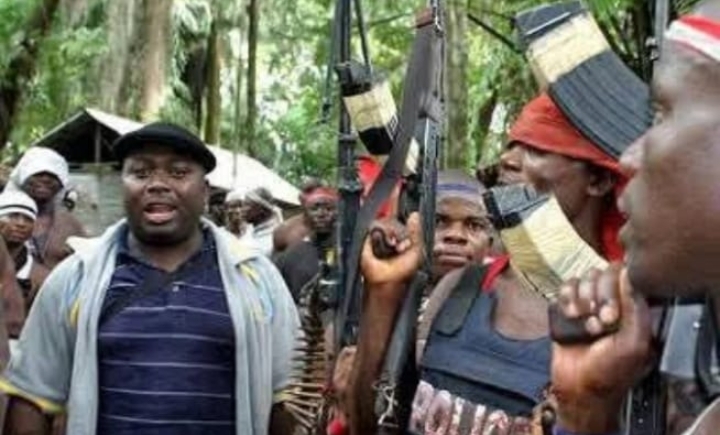
The shift from agitation to organised armed violence became visible around the 2003 elections. In Rivers State, the Niger Delta People’s Volunteer Force (NDPVF), led by Dokubo-Asari, and the Niger Delta Vigilante (NDV), led by Ateke Tom, fought over communities, waterways, and illegal oil-bunkering routes. Human Rights Watch’s February 2005 report, Rivers and Blood: Guns, Oil and Power in Nigeria’s Rivers State, named both groups as the main perpetrators of the violence. It also found strong evidence that senior state government officials had at one time given both leaders financial or logistical support, laying the foundation for a conflict that spun out of control.
In September 2004, Dokubo-Asari threatened an all-out war against the federal government and oil companies unless resource-control demands were met, setting an October 1 deadline for operations to stop in an offensive he called Operation Locust Feast. The threat unsettled energy markets, and contemporary reporting linked it to crude prices rising above $50 a barrel for the first time. Fighting between his group and Ateke Tom’s had already forced federal military intervention. A deal reached on October 1 was meant to disband both militias, but it soon fell apart.
The cost fell on ordinary people. Human Rights Watch documented that the violence killed dozens, displaced tens of thousands, destroyed homes and property, and disrupted schools and businesses. Shell reportedly shut a facility producing about 28,000 barrels daily because security concerns blocked access. Those who paid the price had no command over the militias and no say in how petroleum revenue was shared.
Specific incidents are on record. Human Rights Watch found substantial evidence of destroyed homes, schools, and churches in Tombia, Ogbakiri, and Bukuma between January and May 2004. It concluded that NDPVF attacks at Amadi Ama and Okrika killed at least sixteen people and displaced several hundred residents, and that a raid on the Njemanze waterfront in Port Harcourt left residents without homes and possessions. Members of the group told researchers the aim was to eliminate or kill members of Ateke Tom’s force. HRW estimated that dozens died in the raids overall, mostly fighters but also many bystanders.
The same record points to money and politics. HRW reported that both leaders armed recruits with sophisticated weapons and speedboats in late 2003 to contest bunkering routes in the Cawthorne Channel, and rights activists said both groups financed themselves through bunkering. HRW’s later reporting added that Dokubo-Asari helped rig the 2003 elections in Rivers before falling out with the administration of Governor Peter Odili, who has denied any relationship with armed leaders. Responsibility here is shared, and sponsors answer alongside fighters.
The state eventually acted on speech more than violence. Dokubo-Asari was arrested on September 20, 2005, after a newspaper interview in which he reportedly called Nigeria an evil entity and spoke of its dissolution. On October 6, 2005, he was arraigned at the Federal High Court in Abuja on a five-count charge covering conspiracy, treasonable felony, running an unlawful society, publishing a false statement likely to cause alarm, and membership of an unlawful society. He pleaded not guilty. The Court of Appeal and the Supreme Court, in a June 8, 2007 judgment, refused bail, yet he was freed on bail on June 14, 2007, on health grounds and amid a wider political settlement with the Niger Delta groups. No conviction appears in the public record.
The insurgency then widened. Armed groups that listed his detention among their grievances, notably the Movement for the Emancipation of the Niger Delta, escalated attacks on oil facilities. The government’s Technical Committee on the Niger Delta, chaired by Ledum Mitee, reported that Nigeria lost at least $23.7 billion to shut-ins, sabotage, and theft in the first nine months of 2008, including about $20.7 billion from attacks on installations and a further $3 billion in stolen oil, and that about 1,000 people were killed in that period.
His recent record on the Igbo is documented. In a widely circulated 2023 video, in which he displayed an AK-47 rifle, he reportedly said that but for the British he would still be selling Igbo people as his father did, and described them as people who do not know their roots. In July 2023, after meeting President Tinubu, he said he would gather a million signatures for Igbo secession. The Ohanaeze Youth Council demanded his arrest, and months later allAfrica reported that the authorities had still not acted. The Malaysian remarks, therefore, fit an established pattern.
The labels in this debate deserve a direct answer. The Igbo are not a militant organisation, a terrorist movement, or a bandit network. They are a diverse population of millions, while the armed groups of the Niger Delta had names, leaders, locations, and documented commanders. The NDPVF was led by Dokubo-Asari, the NDV by Ateke Tom, and MEND emerged later as a separate coalition. If an individual Igbo person commits a crime, he answers for it under the law. By the same logic, the Ijaw and the wider Niger Delta, whose civilians suffered most from the militias, are not collective culprits either.
Fairness requires acknowledging complexity. Legal commentators such as Chidi Odinkalu have argued that the 2005 prosecution placed Dokubo-Asari and Niger Delta advocates beneath the law through an expansive national security doctrine. Human Rights Watch warned in 2005 that amnesty for people responsible for killings would deepen impunity, and the 2009 Presidential Amnesty later brought more than 20,000 fighters into a rehabilitation programme. The lesson is not that he deserves immunity. It is that selective prosecution and selective pardon have left victims without answers.
Public figures with large followings carry a duty beyond personal opinion. Ethnic generalisations, especially from a man who has displayed weapons on camera, can inflame suspicion between communities that already carry the memory of earlier violence. Civil society, political leaders, and the security agencies should answer such rhetoric through lawful means and apply the same evidentiary standards they demand for everyone else.
Daniel Nduka Okonkwo is an investigative journalist, human rights advocate, and policy analyst based in Nigeria. He is the founder and publisher of Profiles International Human Rights Advocate (PIHRA), a platform documenting the courage of human rights defenders and examining issues of governance, accountability, security, and fundamental rights.
His reporting on Nigerian governance, security-sector accountability, public finance, and human rights has appeared in Sahara Reporters, Vanguard, Daily Trust, African Defence Forum, Opinion Nigeria, and Daily Intel.
Read more of his work on the PIHRA website:
https://www.profilesinternationalhumanrightsadvocate.com.ng/
For tips, feedback, or collaboration, contact him at dan.okonkwo.73@gmail.com.