





























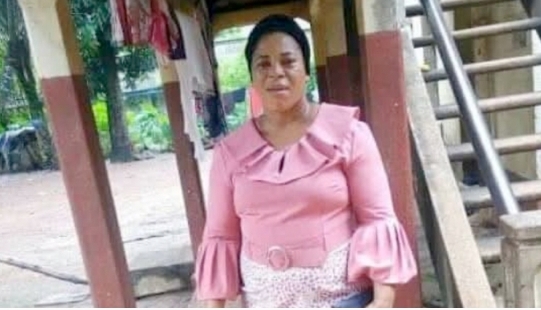
The State Security Service (SSS) has now admitted what it long hid from the Nigerian public. Calista Ifedi died in its custody at Wawa Barracks. She did not die during the court trial. She did not die after conviction. She did not die after the sentence. She died under illegal detention. She died unseen, unheard, and unprotected by the same state that held her against her will and without recourse to the Constitution that guarantees the protection of her rights and the preservation of life.
This admission is not an act of candour. It is an indictment. It confirms that a Nigerian citizen was abducted from her home, detained without due process, denied medical care, and allowed to die in the custody of an agency that answers to no one and fears nothing.
Mrs Ifedi was arrested on November 23, 2021, in Enugu alongside her husband, Sunday Ifedi. Their alleged crime was as banal as it was grotesque in its consequences. Members of the Indigenous People of Biafra (IPOB) were said to have purchased food at her restaurant. For this, she was violently taken away by the SSS, disappeared into detention, and was unalived and erased from the protection of the law. There was no arraignment.
There was no charge known to any court of competent jurisdiction. There was no access to lawyers. There was only silence. In March 2022, both the husband and wife were moved from the SSS headquarters to the Wawa Barracks. They were separated and never allowed to see each other again. Mrs Ifedi would die in that place. Her husband would remain alive, detained, and uninformed of her fate until his release in December 2025. The cruelty of that silence is difficult to comprehend. The husband of a dying woman was kept alive in ignorance while the state buried his wife in secrecy.
Amnesty International Nigeria, Omoyele Sowore and a motley of human rights activists persisted in asking questions that the SSS refused to answer. For years, the SSS denied knowledge of Mrs Ifedi’s whereabouts. Now, it concedes that she died in custody. It has not produced her body. It has not named those responsible. It has not explained the circumstances of her death.
What is known is enough.
While detained at the Wawa Barracks, Mrs Ifedi fell ill. She complained repeatedly. She was ignored. She was mocked. She was denied medical attention. She was left to deteriorate until death came. That death was not an accident. It was the product of neglect in a place designed to operate outside scrutiny. It was the consequence of an institutional culture that treats detainees as expendable. The Wawa Barracks must be named for what it is. A place of unlawful detention.
A black site in all but name. A stain on the Nigerian state. The death of Mrs Calista Ifedi did not occur in isolation. It occurred within an agency that has normalised detention without trial and punishment without judgment. It occurred under the leadership of Yusuf Bichi as Director General of the DSS, during a period when impunity flourished under the political protection of Abubakar Malami, SAN, and the authoritarian temperament of Muhammadu Buhari’s administration. Responsibility must be placed where it belongs. History does not absolve by silence.
This is not strange to me. I know the putrid smell of solitary detention. I know the cast of fear manufactured by the secret police. On May 4, 1991, I was abducted by the State Security Service and taken to its detention facility called Intercentre in Ikoyi, Lagos. For one month, I was held in solitary confinement. No trial. No court. No certainty of release.
I was later transferred under the State Security and Detention of Persons Decree No. 2 of 1984 to the Maximum Security Prison in Kirikiri. My offence? I was simply the President of the National Association of Nigerian Students, the irreverent student body that challenged the dictatorship of General Ibrahim Babangida. That month at Intercentre remains the most harrowing chapter of my years of detention during military rule. The isolation was total. The power was absolute.
The human person was reduced to an object to be stored, moved, and broken at will. Intercentre was designed to erase time, dignity, and hope. What has changed since then is not the secret police’s instinct but the regime’s costume. The State Security Service (SSS) did not reform itself into what it now bears despite the Act that created it, the Department of State Service (DSS). It has merely rebranded itself. The habits of secrecy, contempt for law, and hostility to freedom still endure. Mrs Ifedi became a victim of that continuity.
The idea that national security demands abandoning the law is fundamentally untrue. No society secures itself by killing innocent citizens in detention. No state strengthens itself by allowing its security agencies to operate as law unto themselves. Security that consumes the lives of the innocent is not security. It is state-administered terror. Mrs Ifedi deserved life. She deserved dignity. She deserved the protection of the Constitution. The state owed her a duty of care once it seized her. That duty was breached. The breach resulted in death. Under any serious administration of the criminal justice system, this would constitute a crime.
Nigeria must shut down the Wawa Barracks detention facility. Do not reform it. Do not rename it. Shut it down. Every official involved in the arrest, detention, neglect, and concealment of Mrs Ifedi’s death must be identified and prosecuted. The chain of command responsibility applies in this case. Silence at the top is complicity. Her body must be produced. An independent autopsy must be conducted. The truth must be placed on record.
Nigerians and the nation’s conscience require nothing less. This is not about one woman. It is about whether Nigerians can exist outside the reach of arbitrary power. It is about whether the law restrains the gun or bows before it. It is about whether memory will defeat impunity. Mrs Ifedi is dead because the SSS believed it could act without consequence. That belief has been reinforced by years of official indulgence. It must end.
To remember her is to refuse silence. To write this is to bear witness. To demand justice is to affirm that even in death, the victim speaks.
If Nigeria is to have a future grounded in freedom, the graves dug by its security agencies must be exposed to the light. Mrs Calista Ifedi must not be allowed to disappear twice.
First into detention, then into forgetting.
Abdul Mahmud, a human rights attorney in Abuja.