



































As the 2027 general election draws nearer, Nigeria’s judiciary finds itself under an unforgiving spotlight. The pattern of judicial decisions emerging from the courts has become deeply troubling, with no fewer than seven of the 21 political parties recognised by the Independent National Electoral Commission (INEC) currently entangled in active court cases. When judges openly receive mansions worth N500 million from the executive arm, and when courts deliver judgments that systematically disadvantage opposition parties, the question inevitably arises: can a judge be truly neutral in Nigeria?
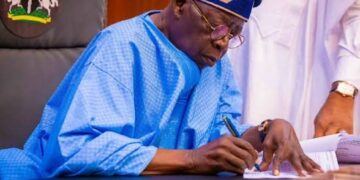
The recent inauguration of the Court of Appeal Abuja Division Building Complex and the construction of 40 judges’ quarters in the Katampe District have reignited a fundamental debate about the boundaries between the executive and judicial arms of government. President Bola Tinubu described the project as “a statement that under the Renewed Hope Agenda, the rule of law will have a befitting home”. Yet a critical examination reveals that such projects, financed with public funds, should not be presented as favours from political office holders.
The concern is not about whether judges deserve decent accommodation, they undoubtedly do. The concern is about perception. Any observer with a grasp of judicial ethics would recognise that a judge cannot be seen to be receiving cars or houses from those who may one day appear before their bench. The construction of these quarters, celebrated with partisan fanfare, creates the unmistakable appearance that judicial welfare is dependent on executive benevolence rather than constitutional entitlement. This is not mere sentiment; it is the bedrock principle upon which the separation of powers rests.
In constitutional democracies founded on the doctrine of separation of powers, the judiciary must not be portrayed as benefiting from the generosity of political actors whose actions could eventually be subject to judicial scrutiny. When the ruling party celebrates such projects with partisan fanfare, the constitutional boundaries between the executive and judicial arms of government become dangerously blurred. The symbolism matters enormously: a judge who resides in a house provided by the executive, no matter how worthy the intention, carries an invisible burden that no amount of personal integrity can fully erase.
Nigerian law is unequivocal on this matter. The Constitution and the Code of Conduct for Public Officers explicitly prohibit the offering of any property, gift or benefit to a public officer as an inducement or bribe. The Corrupt Practices and Other Related Offences Act 2000 criminalises corruption and bribery, with Section 10(a)(i)(ii) providing for the prosecution of offenders. The Revised Code of Conduct for Judicial Officers, 2016, further sets stringent standards for judicial conduct, violations of which have led to the suspension of judges.
Yet the very existence of these laws underscores the recognition that judicial independence is not automatic, it must be protected against encroachment. The National Judicial Council has repeatedly cautioned judges to desist from issuing conflicting orders, while the Nigerian Bar Association (NBA) has warned lawyers against filing cases programmed to cause judges to issue conflicting orders. The enforcement of these provisions, however, remains uneven. The gap between the law on paper and the law in practice has become a chasm, and it is into this chasm that public confidence in the judiciary has fallen.
The legal framework assumes a judiciary that is institutionally robust enough to resist inducement, but it fails to account for the subtle psychology of gratitude. A judge who receives a mansion from the executive may not consciously alter their rulings, but the subconscious obligation to reciprocate, however faint, is a corrosive force that eats away at the very foundation of judicial neutrality. The law prohibits overt bribery, but it cannot legislate against the quiet erosion of independence that comes from dependency.
The erosion of public confidence is not merely theoretical. Consider the case of a judge who ordered the de-registration of an opposition party, a decision that effectively silenced a segment of the political opposition and removed it from the electoral playing field. Consider the case of Segun Olowookere, who as a 17-year-old was sentenced to death by hanging for stealing a fowl and eggs in Osun State, and who had already spent 14 years in prison for the same offence before the sentence was pronounced. The governor of Osun State eventually ordered his pardon, but the damage to public faith in the judiciary had already been done.
These cases are symptomatic of a broader malaise that can only be described as judicial banditry. What Nigerians are witnessing is the dangerous judicialisation of opposition politics, where courts are reshaping leadership structures through injunctions, suspending or reinstating party executives at will. The Hon. Justice Lifu episode, where judgment was delivered in contempt of a subsisting Court of Appeal order, represents the most egregious manifestation of this trend. When a judge disregards a higher court’s order, the entire hierarchy of judicial authority collapses into chaos.
Conflicting court judgments involving INEC ahead of the 2027 elections could create uncertainty capable of undermining the electoral process. In one instance, a Federal High Court invalidated INEC’s timeline for party primaries, while another judge of coordinate jurisdiction affirmed INEC’s authority to issue the same timetable. Such contradictory rulings from courts of equal jurisdiction weaken public confidence in the judiciary and the electoral process. The spectacle of judges contradicting one another on fundamental electoral matters presents a picture of a judiciary that has lost its moral compass.
There was a time when the Nigerian judiciary commanded greater respect. During the military era, when constitutional order was suspended and fundamental rights were routinely violated, certain judges demonstrated remarkable courage and integrity. Justice Kayode Eso and others stood firm against executive overreach, and the judiciary, despite the ouster of its jurisdiction through military decrees, provided a measure of protection against human rights violations.
The military regime of General Sani Abacha even established the Justice Kayode Eso Panel on the Re-organisation of the Judiciary in 1993, acknowledging the need for judicial reform. The late Chief Justice Mohammed Lawal Uwais was described as a man for whom judicial integrity was a way of life and an independent judiciary was a constitutional mandate of the highest salience. He underscored the need to eliminate bribery, corruption, nepotism and political interference within judicial systems.
That legacy now appears under threat. The judiciary was known to be the last hope of the common man and also the hope of those cheated under the law. But alas, the opposite has become the case with Nigeria’s judicial system. The very institution that helped the nation survive the dark days of military rule now appears to be steering the country back toward those same dark days. The irony is profound: judges who once stood as bulwarks against tyranny are now perceived as instruments of executive control.
The question of whether the judiciary can tame executive recklessness is intimately linked to its independence. An independent judiciary, equipped with institutional autonomy, financial independence, security of tenure and freedom from political pressure, can serve as a check on executive power. A judiciary that is perceived as beholden to the executive cannot.
The judges’ quarters project, whatever its intentions, reinforces the perception of dependency. When the executive provides housing, when the executive provides vehicles, when the executive celebrates these provisions as acts of benevolence, the message is clear: the judiciary is a beneficiary of executive goodwill, not a co-equal branch of government. The third arm of government, constitutionally designed to check the excesses of the executive, has become a supplicant at the executive’s table.
This perception is particularly dangerous as the 2027 elections approach. Nigeria’s democracy faces a deepening legitimacy crisis if the judiciary continues to determine electoral winners instead of the ballot box. Politicians now rush to court after elections because they believe judges can be manipulated to overturn the will of the people. This is not a healthy democracy; it is a judiciary-controlled oligarchy wearing the mask of democracy.
The threat extends beyond electoral manipulation. There are warnings that the country risks sliding into anarchy, with the disturbing role of the judiciary as a primary driver. When the institution meant to uphold the rule of law becomes a tool of political manipulation, the very fabric of society begins to unravel. The potential for a military coup, once unthinkable, now hovers at the edges of political discourse.
The construction of judges’ quarters, while well-intentioned, has inadvertently exposed the fragility of judicial independence in Nigeria. The law prohibits the offering of gifts or benefits to judges as inducements, yet the executive openly provides mansions worth hundreds of millions of naira and celebrates these provisions as personal achievements. The pattern of judicial decisions favouring the ruling party and penalising the opposition has become unmistakable.
The Nigerian judiciary must recognise that its legitimacy rests not on the comfort of its accommodation but on the integrity of its judgments. As the nation approaches the 2027 elections, the courts will face one of their most significant tests. If they fail that test—if they continue to issue contradictory rulings, if they continue to de-register opposition parties on questionable grounds, if they continue to hand down disproportionate sentences that mock the principle of proportionality—then the judiciary will have forfeited the trust that once made it the last hope of the common man.
The path back to the glorious years of judicial integrity requires more than comfortable housing. It requires a judiciary that is institutionally autonomous, financially independent, and fiercely protective of its constitutional role. It requires judges who understand that their duty is to the constitution and the people, not to the executive that provides their accommodation. The alternative is a democracy under threat, and potentially, the return of the dark days that the nation’s judges once helped the country to survive.
The question that remains unanswered is whether the current judiciary has the courage to reclaim its independence, or whether it has become so comfortable in its executive-provided mansions that it has forgotten the constitutional duty that those mansions were meant to enable. The answer to this question will determine not only the fate of the 2027 elections but the very future of Nigerian democracy itself.