








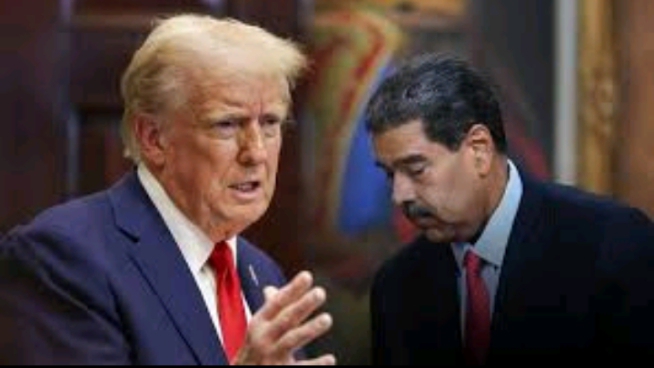
No one will intervene decisively on behalf of Nicolás Maduro and his wife. The international outcry over accusations that the United States has violated Venezuelan sovereignty, whether through sanctions, indictments, or covert pressure, tends to fade with time. History suggests that few nations are willing to jeopardize strategic ties with Washington over the fate of a single leader, and any eventual post-Maduro government in Venezuela is likely to recalibrate its relationship in favor of the United States.
For Maduro, the legal and political pressures appear unrelenting. For discerning leaders elsewhere, however, this moment signals the opening of a new chapter, one rich with cautionary lessons.
Leadership demands foresight: the ability to perceive the end from the beginning. When others beat the drums of war on a leader’s behalf, wisdom lies in understanding one’s limits and avoiding a humiliating descent. Exiting the stage while applause still lingers can spare a nation and its leader avoidable disgrace. Those who ignore this reality often encounter consequences that might have been averted.
The roots of Maduro’s predicament lie, according to U.S. authorities, in long-standing entanglements with actors deemed hostile to American interests. Allegations of large-scale drug trafficking, links to designated terrorist organizations, and deepening ties with Iran, combined with controversial practices attributed to previous Venezuelan administrations, form the backbone of Washington’s case. While intelligence disclosures may yet evolve, the broader pattern advanced by U.S. policymakers is consistent: alliances with adversarial powers carry consequences.
In a previous article, I argued that nations lacking the capacity to confront a superpower should proceed with caution. Developing states, or those emboldened by external encouragement to challenge the United States, must reflect carefully on Venezuela’s experience. Challenging overwhelming power without the means to sustain such defiance is not courage; it is strategic miscalculation.
This episode stands as both a warning and a guide. Leaders must choose between pride and prudence, between reckless defiance and strategic restraint. Ignoring these lessons is to court avoidable disaster.
To understand how matters reached this point, one must look beyond a single event or administration. The U.S. posture toward Maduro is not presented by Washington as an impulsive assertion of power, but rather as the culmination of decades of intelligence assessments, criminal indictments, geopolitical rivalry, and what can be described as the failure of international institutions, particularly the United Nations, to act decisively against state-enabled terrorism and transnational crime.
At the core of Washington’s position is a long-standing allegation: that elements within Venezuela’s leadership transformed state institutions into facilitators of narco-terrorism, money laundering, and cooperation with designated terrorist organizations, some of which maintain ties to Iran.
U.S. unilateral action could lie in the unresolved legal framework of the United Nations regarding terrorism. While the UN has adopted multiple counter-terrorism conventions, covering terrorist financing, aviation security, and nuclear terrorism, it has never agreed on a single, comprehensive legal definition of terrorism.
This ambiguity has frequently constrained multilateral enforcement. States accused of harboring or enabling terrorist actors have, at times, exploited political divisions within the UN system, particularly within the Security Council, where enforcement depends on consensus and is often blocked by veto power or strategic alliances.
This gap reinforces a long-standing doctrine: when multilateral mechanisms stall and a direct security threat is perceived, the United States reserves the right to act through domestic law, extraterritorial indictments, sanctions, and other unilateral measures.
Concerns over Venezuela’s alleged ties to extremist groups predate Nicolás Maduro. Intelligence assessments trace these concerns back to the presidency of Hugo Chávez, whose government openly aligned with Iran as part of an anti-U.S. geopolitical bloc.
According to intelligence-linked accounts cited by U.S. and regional sources, a pivotal moment allegedly occurred on August 22, 2010, when Chávez hosted a confidential meeting in Caracas involving senior figures from Hamas, Hezbollah, and Palestinian Islamic Jihad, organizations designated as terrorist groups by the United States. The meeting was reportedly held at the Fuerte Tiuna military intelligence complex, suggesting state-level facilitation. Those reportedly present included:
Ramadan Abdullah Mohammad Shallah (Palestinian Islamic Jihad),
Khaled Meshal (Hamas),
and a senior Hezbollah operations figure.
Their alleged presence outside traditional operational zones was interpreted by intelligence analysts as an indication of confidence in protection from Venezuelan authorities.
Hezbollah, Drug Trafficking, and Venezuelan Documentation
U.S. and regional intelligence agencies have repeatedly pointed to Hezbollah’s operational footprint in parts of South America, allegedly facilitated through Venezuelan diplomatic channels. One frequently cited individual is Ghazi Nassereddine, a Venezuelan diplomat of Lebanese origin, accused by U.S. authorities of coordinating Hezbollah-linked regional activities.
Related allegations have surfaced in connection with Walid Makled, a convicted drug trafficker indicted in the United States, who claimed to possess evidence implicating senior Venezuelan military officials in cocaine trafficking networks.
Further accusations suggest that Venezuelan passports and identity documents were issued to non-nationals from the Middle East, including individuals considered security risks. Tarek El Aissami, a close Chávez ally and former interior minister, is repeatedly named in these claims, though Venezuelan authorities have consistently denied wrongdoing.
Washington’s assessment of Venezuela evolved from regional concern to hemispheric risk as the Iran-Venezuela alliance deepened. U.S. officials point to actions such as:
Iranian fuel shipments to Venezuela despite sanctions,
expanded energy and military cooperation,
high-level strategic exchanges,
and alleged ideological and paramilitary training links.
Some intelligence reports claim that recruits from Venezuela and Colombia traveled to Qom, Iran, under religious or educational cover, with a subset allegedly receiving weapons or explosives training before returning home. Iran and Venezuela have categorically denied these accusations, but U.S. officials argue that the pattern mirrors Tehran’s proxy strategies elsewhere.
Rather than conventional military intervention, the United States has primarily pursued what analysts describe as criminal lawfare against Maduro. Federal indictments unsealed in New York accuse him and senior officials of:
cocaine-importation conspiracy,
weapons trafficking,
and the use of state institutions to advance criminal enterprises.
According to U.S. prosecutors, these alleged activities date back to 1999 and involve cooperation with groups such as the Sinaloa Cartel, Colombian narco-terrorist organizations, and the Venezuelan gang Tren de Aragua. The Justice Department further alleges that Maduro authorized the misuse of diplomatic channels and documentation to facilitate trafficking operations.
It is within this legal, not military, framework that U.S. officials have spoken of Maduro “facing justice” in American courts.
In 2019, President Donald Trump recognized Juan Guaidó as Venezuela’s interim president, declaring Maduro’s government illegitimate. Venezuela responded by severing diplomatic ties and expelling U.S. diplomats. This marked a decisive shift from pressure to delegitimization, reinforcing Washington’s position that Maduro no longer enjoyed full sovereign protection.
From the U.S. perspective, the issue is framed less as ideology and more as proximity-based security risk. A state accused of hosting terrorist networks, facilitating global drug trafficking, cooperating closely with Iran, and operating near U.S. borders is viewed as an unacceptable threat.
With the UN constrained by legal ambiguity and political division, the United States has historically defaulted to unilateral measures. As American policymakers often argue, when multilateral systems fail, power fills the vacuum.
The Maduro case exposes a sobering truth of international politics: international law without enforcement is aspiration, not restraint. The UN’s inability to uniformly define and prosecute terrorism leaves space for powerful states to act independently, sometimes controversially, sometimes decisively.
Whether Washington’s approach ultimately enhances global security or deepens geopolitical fractures remains debated. What is clear is that Venezuela has become a test case for how far a state can go before sovereignty yields to sustained allegations of terrorism, transnational crime, and hostile alliances.
In the end, poor leadership, corruption, and weak governance, especially when intertwined with global criminal networks, do more than impoverish nations. They invite external pressure through courts, sanctions, and diplomatic isolation.
History suggests that once a state crosses that threshold, the response is rarely gentle.
Daniel Nduka Okonkwo is a seasoned writer, human rights advocate, and public affairs analyst known for his incisive commentary on governance, justice, and social equity. Through Profiles International Human Rights Advocate, he champions accountability, transparency, and reform in Nigeria and beyond. With over 1,000 published articles indexed on Google, his work has appeared on Sahara Reporters and other leading media platforms. He is also an accomplished transcriptionist, petition writer, ghostwriter, and freelance journalist, recognized for his precision, persuasive communication, and unwavering commitment to human rights.
📧 Contact: dan.okonkwo.73@gmail.com