














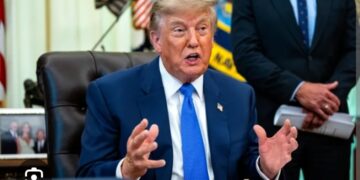







If there is one lesson Nigerians should take from America’s November 3, 2026, midterm elections, it is that voters can surprise politicians who believe they have figured out how elections work.
The American electorate was outraged by the rising cost of living, corruption allegations surrounding President Donald Trump and his allies, the cruelty of his immigration enforcement, and the war with Iran.
On Tuesday, Americans delivered their verdict on the Republican Party.
Will Nigerian voters do the same in 2027?
Americans have their cultural, ethnic, and religious divisions. But when the moment came, many voters put those divisions aside to demand a country where the better angels of their people mattered more than the impulses of those frightened by a fast-changing world.
Their message was simple: a gentler and kinder America is possible.
Which brings me to a prediction that sounds outrageous, almost unthinkable.
If Nigeria’s 2027 election is free and fair, President Bola Tinubu could come third.
I know. But before you dismiss the possibility, consider what we know about Nigerian elections, what we think we know, and what we may be getting completely wrong.
A few weeks ago, The Economist magazine in London suggested that Nigerians dislike President Tinubu but may reelect him anyway.
The magazine offered familiar reasons: religion, ethnic divisions, political cynicism, incumbency, and disunity among the opposition.
It was a projection based largely on conventional wisdom. And conventional wisdom becomes dangerous when people mistake it for prophecy.
The Republicans in America have just received a lesson in that regard.
The conventional wisdom about Nigeria goes something like this: Nigerian elections are flawed and will remain so. Those flaws favor incumbents. Nigerian voters are too disillusioned to participate. Those who vote will follow familiar ethnic and religious loyalties, while others will be persuaded by whatever crumbs politicians throw their way.
In 2023, only about 27 percent of registered voters were accredited to vote. Today’s conventional wisdom expects another low turnout in 2027.
With the opposition divided and the incumbent controlling the machinery of government, some analysts have already written their results and filed them under the headline, “Tinubu returns to Aso Rock.”
Case closed. Folks, move on to 2031.
But what if the case is not closed?
The people sitting in the swanky offices of London may understand the mathematics of Nigerian elections. But do they fully understand what is happening to people living under bridges and struggling to survive in Lagos, Kano, Otuoke, and Abakaliki?
Nigerians want infrastructure built, but not via unbided contracts handed over to the president’s friends and with loans whose servicing threatens to consume their country’s revenues. They want a strong economy and livable wages, but they do not want to die before prosperity arrives.
For years, observers have watched Nigerians cry, Ebi n pa wa! (We are hungry!) and concluded that their anger would amount to nothing.
They have watched people complain about corruption, insecurity, unemployment, and the rising cost of living, only to reproduce the same political arrangements at the polling booths.
And, to be fair, Nigerian voters have repeatedly given them reasons to think so.
But there is something conventional wisdom may be missing.
A population that has endured hardship for too long may reach a point where the old political calculations no longer apply.
Consider what has happened since 2023.
When Tinubu campaigned for president, he was not responsible for the economic conditions Nigerians were living in. He could blame Muhammadu Buhari, promise a better tomorrow, and invite voters to trust his experience.
Some Nigerians genuinely believed him.
Then Tinubu became president. And as he promised, he continued where Buhari stopped.
And Nigerians began to see shege squared.
Not the ordinary shege that Jesus may have anticipated when he observed that the poor would always be with us. This is the kind of shege that makes ordinary people stand by the roadside and shout at the president’s convoy in Lagos, his political hometown.
“We are hungry!” some have cried.
“Ole! Ole!” others shouted.
And in Kaduna, the cry of “Ba ma yi” (we don’t want it again) has entered the political conversation.
I do not know what these people will do next. But I suspect that whatever they say may be accompanied by a generous gesture of waka.
Yet conventional wisdom says these same people may still vote for Tinubu.
That is the Nigerian electoral paradox.
People can be angry with a government and still vote for it. They can suffer under a policy and still defend the politician responsible for it. Religion, ethnicity, patronage, fear, and the absence of credible alternatives can produce such contradictions.
But how long can that arrangement last?
Following The Economist’s publication, the Tinubu administration challenged the magazine’s assessment and defended the hardship as the unavoidable cost of necessary reforms.
Nigerians were assured that prosperity was on its way.
The wagon of prosperity, it seems, is descending from the North Pole with Santa Claus or, as Nigerians know him, Father Christmas.
Unfortunately, Nigerians cannot eat economic projections. They cannot pay school fees with promises of future prosperity. And they cannot persuade a hungry child to wait until macroeconomic indicators finally arrive at the family dining table.
This does not mean economic hardship automatically produces electoral defeat.
But it means the political conditions in 2027 are not those in 2023.
Since reliable nationwide polling is difficult to come by, I tried a little electoral arithmetic. I was too lazy to use a calculator, so I asked DeepSeek to examine the 2023 presidential election results.
What would have happened if Peter Obi and Rabiu Kwankwaso had run on a single ticket, combining their votes?
Obi received 6,101,533 votes, while Kwankwaso received 1,496,687. Together, that is 7,598,220 votes, still below Tinubu’s 8,794,726.
But I knew that all things were not equal.
Votes do not transfer automatically because politicians form alliances. Supporters have minds of their own.
More importantly, Tinubu was not president in 2023. Today, he enjoys the enormous advantages of incumbency, including federal patronage and powerful political networks.
By political resources, I mean, among other things, the capacity to provide 36 brand-new Prado SUVs to youth leaders expected to mobilize support.
But incumbency also comes with liabilities.
In 2023, Tinubu could promise to fix Nigeria. In 2027, voters can examine what he has done with the opportunity they gave him.
Then there is the North, particularly the North East and North West.
Anyone who assumes northern voters will behave exactly as they did in 2023 may be making a dangerous assumption.
Economic hardship, insecurity, regional interests, and the ambitions of northern political leaders are all part of the equation.
There are echoes of the political realignments that preceded Goodluck Jonathan’s defeat in 2015.
Jonathan discovered that an incumbent could possess the machinery of government and still lose an election.
Could Tinubu face a similar realignment?
And what role will Atiku Abubakar play? Can the northern political establishment produce a united response to Tinubu, or will competing ambitions once again divide its strength?
Then there is Peter Obi.
Some commentators have begun to downplay his reach in 2027. Interestingly, some of those making such assessments underestimated him before 2023.
Obi received more than six million votes. Those votes cannot simply be wished away.
Nor can they be assumed to remain intact.
The question is whether Obi can retain his support, expand beyond his strongest constituencies, and attract Nigerians who stayed home in 2023.
And here is where things become interesting.
In 2023, Nigeria had approximately 93.5 million registered voters. Only 25.3 million were accredited to vote. More than 68 million registered Nigerians did not participate.
Imagine what could happen if even a fraction of those people decided to vote in 2027.
A candidate like Prince Adewole Adebayo or Omoyele Sowore, who attracted relatively few votes in 2023, could find himself addressing an entirely different electorate.
The political establishment has built much of its calculations around people who habitually show up at polling units.
But what about those who stay home?
Suppose northern voters move significantly away from Tinubu. Suppose Obi retains much of his Southeast support while expanding into the Middle Belt and South-South. Suppose an Obi-Kwankwaso alliance changes the political calculations in Kano and other northern states.
None of these outcomes is guaranteed.
And for Tinubu to come third, something more dramatic must happen. Two opposition candidates or alliances would have to win more votes than he does.
That is a much more demanding scenario than merely defeating an incumbent.
But it is not beyond examination.
The greatest unknown is turnout.
What if young Nigerians who have spent years insulting politicians on social media decide that posting another comment on Facebook or X is not enough?
What if millions of Nigerians who stayed home in 2023 decide to participate in the 2027 election? While a higher turnout would not automatically defeat a government in power, by participating in large numbers, it will make rigging difficult for the likes Nyesom Wike, trader in impunity. What if votes are protected through credible election administration, security, and transparent collation.
Meanwhile, with opposition politicians struggling to find safe campaign venues, there are already troubling questions about whether the contest will be fair.
That is why the condition in my prediction matters.
Even though Bishop Michael Nwaobi Amakaeze (Musa) is from my hometown of Nnobi, my prediction is not a prophecy. Nor is it based on a secret opinion poll.
It comes from recognizing that voters can change faster than political analysts’ expectations.
The 2015 election demonstrated that an incumbent could be defeated. The 2023 election demonstrated that a candidate outside the two dominant parties could attract millions of votes.
Neither tells us what will happen in 2027.
Perhaps The Economist will be vindicated by INEC in the early hours following the presidential election, while Nigerians are sleeping.
Perhaps Nigerians will complain bitterly about their suffering and still return the same political arrangement to power.
Or perhaps the electorate will surprise us all.
And if conventional wisdom wins again, four years later, on the eve of the 2031 presidential election, we may find ourselves discussing the same hardship, the same disappointed voters, and the same predictions.
Perhaps by then, The Economist will publish another article explaining why Nigerians dislike their vice president but may elect him president anyway.
And perhaps I will be sitting here, once again, asking the same question.
What if the Nigerian voter finally surprises us?