




















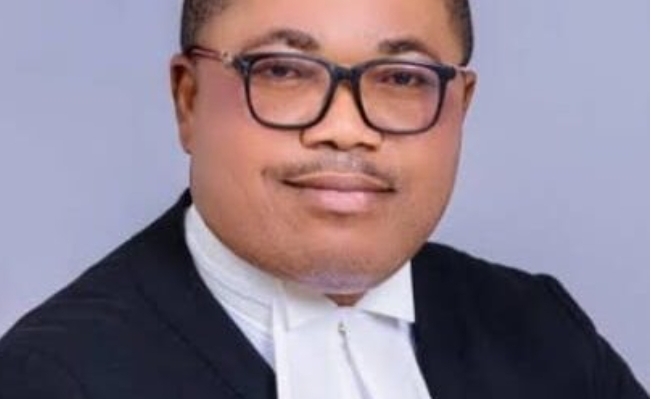
Human rights lawyer and social justice advocate, Mr Ifeanyi Ejiofor, has decribed the increasing wave of political violence as ” disturbing”, warning that the renewed rivalry and clashes over who controls campaign billboards may undermine the credibility and outcome of the 2027 general elections.
In statement on Monday, in Abuja, Mr Ejiofor referenced the unwarranted attack and disruption of Peter Obi’s Nigeria Democratic Congress (NDC) rally by thugs sponsored by rival party in Warri, Delta State.
He also cited the Ideato, Imo State incident, where rival political thugs pulled down campaign billboards belonging to Hon. Ikenga Imo Ugochinyere and other opposition candidates.
The Anambra born rights lawyer argued that the larger issue, however, transcends Warri or Ideato.
He pointed out the real challenge lies on “the dangerous normalisation of political confrontation in which disagreement is increasingly treated as an invitation to hostility.”
According to him, political billboards are not worth human blood, likewise political parties are not worth the destruction of friendships, communities or lives.
No candidate, however beloved, should become the reason one Nigerian raises a weapon against another Nigerian.
The statement reads:
“There is something profoundly disturbing about the increasingly violent undertones accompanying political mobilisation across different parts of Nigeria. What may presently appear as isolated skirmishes, billboard controversies and clashes between rival supporters could, if left unchecked, become a far more dangerous national phenomenon as the 2027 General Election approaches.
“Recent events ought therefore to command the attention of every discerning citizen.
In Warri, Delta State, reports emerged of suspected thugs disrupting a mobilisation rally involving supporters of the Nigeria Democratic Congress (NDC) presidential candidate of Peter Obi and Rabiu Kwankwaso. Videos circulated showing a chaotic confrontation, while allegations were made that politically sponsored attackers targeted members of the campaign movement. These remain allegations requiring appropriate investigation, but the very occurrence of such a confrontation is disturbing enough.
“From Ideato in Imo State, another troubling controversy has unfolded around the removal of political billboards belonging to Hon. Ikenga Imo Ugochinyere and other candidates. A Federal Capital Territory High Court had, in an interim order dated 20 July 2026, restrained the Imo State Government, security agencies and other defendants from destroying, dismantling, defacing or removing the billboards, as well as from interfering with certain civic activities.
“The larger issue, however, transcends Warri or Ideato. It is the dangerous normalisation of political confrontation in which disagreement is increasingly treated as an invitation to hostility.
“And herein lies the danger.
Political billboards are not worth human blood. Political parties are not worth the destruction of friendships, communities or lives. No candidate, however beloved, should become the reason one Nigerian raises a weapon against another Nigerian.
“The tragedy is that the youths who are most frequently recruited into these confrontations are often the very citizens bearing the heaviest consequences of unemployment, insecurity and poor governance. Yet, for a token payment or the fleeting satisfaction of defending a politician, some willingly become instruments of violence.
“There is an old wisdom that when two elephants fight, it is the grass that suffers. In our political ecosystem, however, there is an even more painful irony: the elephants often return to the dining table, while the grass is left to count its wounds.
“The politician who sends a young man into a street fight is unlikely to stand beside him when the police arrive. He will probably be somewhere in the comfort of his home, office or convoy, discussing strategy while the young recruit explains himself before a magistrate. After the election, the same youth may discover that his political benefactor has developed the remarkable ability to forget the names of those who fought his battles.
“What a curious political investment: sacrifice your life for another man’s ambition and receive neither a dividend nor a guarantee.
“Security agencies, too, must remain within the boundaries of their constitutional and statutory responsibilities. Where a civil regulatory dispute arises over signage, campaigns or political activities, the resort to military or other armed personnel should not become an automatic substitute for lawful civil processes. Where a court order exists, the proper response is obedience, clarification or lawful challenge—not self-help.
“The lesson for our youths is simple but profound: do not surrender your future to somebody else’s political ambition. Do not allow yourself to become a willing instrument of violence merely because another person has the resources to finance it. You have only one life, one future and one name.
“If political disagreement arises, answer it with argument, organisation, lawful protest, civic engagement and, ultimately, the ballot, not with bottles, stones, machetes, guns or arson.
“The time to extinguish a fire is when it is still a flame, not when the entire house is burning. A stitch in time, as the proverb reminds us, saves nine. If politically motivated violence is allowed to become normal before the 2027 elections, we may discover too late that what we dismissed today as “mere politics” was actually the first warning bell.
“Let every political actor, security institution and citizen therefore understand this solemn truth: an election is temporary; the nation is permanent; political office is transient; human life is irreplaceable.
“Let us disagree passionately, compete vigorously and organise courageously, but let us never make violence the language of our democracy.”